Choosing a squat rack for a basement gym requires balancing stability, build quality, and safety features with your space and training needs. The following selections represent sturdy options from reputable brands, including power racks with wide range of height settings, reinforced safety arms, and integrated pull-up bars. This guide highlights five models well-suited for home basements, covering different budgets and configurations to help you pick a rack that stays solid through heavy lifts and diverse routines.
| Product | Brand | Key Strength |
|---|---|---|
| Sunny Health & Fitness SF-XF9931 | Sunny Health & Fitness | Heavy-duty frame; adjustable pull-up bar |
| Fitness Reality XLT Squat Rack | Fitness Reality | 800 lb capacity; reinforced safety arms |
| YOLEO Squat Rack | YOLEO | Fixed 83” frame; adjustable pull-up bar |
| PASYOU SR30 Squat Rack | PASYOU | High top load; multiple bumpers; sturdy steel |
| JELENS Power Cage S11 | JELENS | 2000 lb capacity; pulley system |
Each selected model emphasizes stability, solid construction, and safety features that are especially important for basement spaces where noise and space constraints matter. The following sections provide concise overviews of five top options, with quick takeaways to help you compare features such as weight capacity, safety arms, pull-up bars, and upgrade possibilities.
Sunny Health & Fitness SF-XF9931 Power Rack Cage
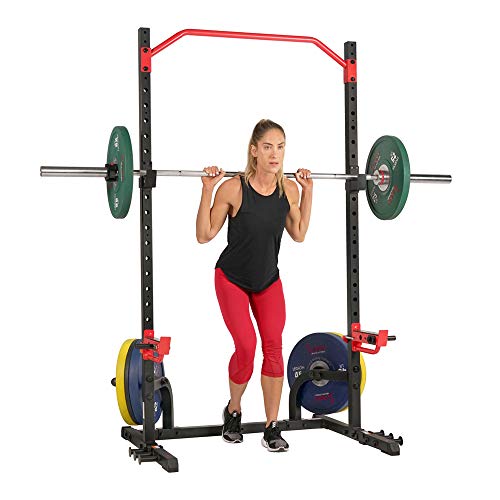
The SF-XF9931 uses a heavy-duty steel frame with a robust maximum weight capacity of 805 lb, making it suitable for intense squat and bench work. An angled, adjustable pull-up bar offers eight positions for varied grip widths, enabling targeted back, shoulder, and arm development. Safety is supported by spotter arms with locking latches to catch weights should a lift fail, aligning with basement training needs where controlled setup and spotter availability can be limited.
Fitness Reality XLT Squat Rack With LAT Pulldown

Built for durability, this rack is rated up to 800 lb and features reinforced safety arms that are thicker than many competitors, offering dependable protection during heavy lifts. A reinforced lat pulldown adds versatility, allowing you to perform pulling movements without needing another machine. The sturdy 2 x 2 inch steel frame provides stability and peace of mind when training alone in a basement environment.
YOLEO Squat Rack With Adjustable Pull-Up Bar

YOLEO offers a fixed 83” frame designed for stability, with an adjustable pull-up bar to fit various user heights. The rack includes upgraded safety arms (16.5”) and durable J-hooks (4”) to securely rack and rerack a barbell during solo training. This model balances a solid base with flexibility for different exercises, making it a versatile choice for basement setups where space efficiency matters.
PASYOU SR30 Squat Rack

PASYOU’s SR30 emphasizes heavy-duty construction with a claimed top-load capability and safe use with bumper plates. The rack design includes multiple bumpers and anti-slip pads to help prevent movement during strenuous sets, which is critical for basement floors that may flex slightly or have uneven surfaces. The unit’s solid steel perforations and wrapped uprights contribute to long-term durability under frequent use.
JELENS Power Cage S11

The JELENS S11 power cage brings a higher-end option to basements with a 2000 lb safe weight rating and an integrated pulley system for lat pulldown and other cable-based exercises. The all-steel construction and laser-marked height options help users set precise positions for different lifts, while the included attachments enable a broader range of exercises without needing multiple machines. This model is suited for serious lifters who want a comprehensive home gym in a single footprint.
Buying Guide: Key Purchase Considerations
- Weight capacity and safety features: Look for racks with high rated capacities and reinforced safety arms or spotter supports. For beginners, a 800–1000 lb capacity often suffices, while seasoned lifters may require 1500–2000 lb or more.
- Stability and floor impact: Basements can have uneven floors or concrete with slight give. Choose a rack with broad base feet, anti-slip pads, and a reinforced frame to minimize wobble during lifts.
- Pull-up bars and attachments: If you want a single machine for multiple workouts, prioritize racks with adjustable pull-up bars and options like lat pulldown, dip stations, or pulley systems.
- Adjustability and height range: Ensure the rack’s height and J-hook positions align with the user’s height and preferred bench/overhead press setup. Wider range promotes versatility for different users.
- Footprint and space optimization: Measure your basement area and compare with the product footprint. Consider foldable or compact models if space is tight, while retaining essential safety features.
- Quality and durability: Look for high-grade steel framing, laser-cut adjustments, and corrosion resistance. Powder coating adds durability in humid basement environments.
- Ease of assembly and maintenance: Check included hardware, clear instructions, and online support for parts replacement or upgrades over time.
- Compatibility with plates and bars: Confirm weight plate storage options and barbell compatibility (standard vs. Olympic) to avoid fitting issues during future upgrades.
These considerations help builders and buyers assess how a squat rack will perform in a basement setting, balancing safety, flexibility, and long-term value. The models listed here offer a mix of sturdy construction, practical features, and room to grow with your home gym.