Duck hunting often hinges on stealth, quick setup, and roomy concealment. This guide highlights five pop-up blinds designed for 3–4 hunters, offering fast deployment, durable construction, and adaptable configurations for various waterfowl environments. Each option provides ample space, wind resistance, and concealed layouts to keep your presence unseen from birds overhead. Below you’ll find concise overviews, visual references, and a practical buying guide to help you pick the right blind for your hunt.
| Product | Brand | Key Benefit |
|---|---|---|
| TIDEWE Hunting Blind Panel with Carrying Bag (RealTree MAX-5) | TIDEWE | Wide footprint with flexible side-linking |
| AUSCAMOTEK Duck Hunting Pop Up Ground Blind | AUSCAMOTEK | Three-panel versatility for camouflage from multiple angles |
| TIDEWE Hunting Blind Panel with Carrying Bag (Next Evos) | TIDEWE | Same spacious design with robust build and wind resistance |
| Hunthor 4 Panel Duck Blind Hunting Tent | Hunthor | Silent operation and quick setup in seconds |
| Phoncoo Hunting Blind, 360 Degree See Through | Phoncoo | 360° visibility for precise shooting |
TIDEWE Hunting Blind Panel With Carrying Bag

The TIDEWE RealTree MAX-5 blind offers a three-to-four-person footprint with a large interior height. With a spacious 102.5″ by 40.5″ base and a standing height of 46.5″, it accommodates multiple hunters while collapsing to a compact travel size (38.5″ x 8.0″ x 8.0″). Weighing about 12.5 pounds, its design prioritizes transportability without sacrificing interior room. Side panels incorporate three outer-edge buckles, enabling seamless linking with additional blinds for extended coverage or an enclosed A-frame feel for enhanced concealment. Built to endure harsh weather, it uses rugged 600D polyester, sturdy fiberglass poles, reinforced corners, and floor loops. Tie-down straps and a durable frame resist winds and wet conditions typical of waterfowl seasons.
TIDEWE Hunting Blind Panel With Carrying Bag (Next Evos)

This Next Evos variant mirrors the same robust design as the RealTree MAX-5 version, delivering a 102.5″ × 40.5″ footprint and 46.5″ interior height for 3–4 hunters. It collapses to a compact size suitable for transport, weighing around 12.5 pounds. The modular side-panel buckles support multi-blind connections for broader coverage or back-to-back configurations for additional concealment. The construction emphasizes durable 600D polyester, fiberglass poles, and reinforced corners, with tie-downs and floor loops to secure the blind against wind and moisture.
Hunthor 4 Panel Duck Blind Hunting Tent

The Hunthor four-panel blind is designed for 3–4 hunters, with dimensions of about 102″ by 40″ and a height of 46″. It collapses to a portable 38.9″ by 7.8″ by 7.8″ and weighs roughly 13 pounds. The setup is quick, taking about 15 seconds, providing rapid concealment in duck or turkey environments. The design emphasizes silent operation, with interior layout tuned for improved aiming precision. It features two dog doors with silent sliding tracks and multiple pockets and ammo holders for gear management within reach.
Phoncoo Hunting Blind, 360 Degree See Through
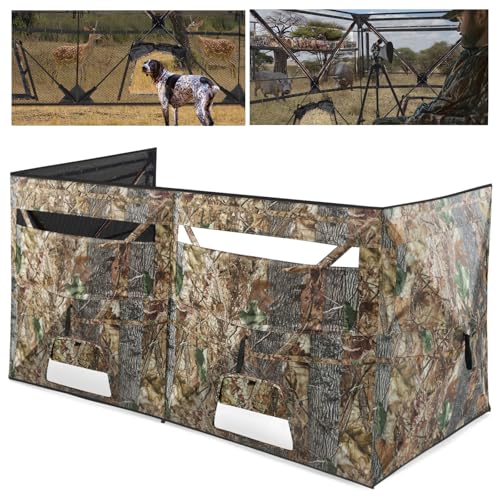
The Phoncoo blind offers a full 360° see-through experience with four one-way panels, allowing unrestricted observation from multiple angles for deer, turkey, duck, and other big-game hunts. Its camouflage integrates with wilderness environments, aided by zipper-connected panels that enable quick configuration with other blinds. Silent, adjustable windows facilitate shot setup without spooking game, providing quiet operation and versatile positioning for varied terrains and angles.
Buying Guide: Key Purchase Considerations
- Size and capacity: For 3–4 hunters, prioritize blinds around 102″ long with a height around 46″ to keep everyone comfortable while preserving movement space.
- Concealment and camouflage: Look for patterns matching your typical hunting area (e.g., marsh grass, reeds). Multiple panels and the option to add natural vegetation enhance concealment.
- Setup speed and portability: Pop-up designs should deploy in seconds to minutes. Consider weight (roughly 12–13 lbs) and folded dimensions for backpacking or vehicle transport.
- Durability: Choose rugged fabrics (e.g., 600D polyester) with reinforced corners and robust poles to resist wind, rain, and abrasion from vegetation.
- Ventilation and visibility: Adequate air flow reduces condensation and heat buildup. Look for windows that allow quiet operation and good line-of-sight without flaring game.
- Modularity: Some models enable linking multiple blinds for extended coverage or flexible layouts (side-by-side or back-to-back). This helps tailor concealment to your terrain.
- Accessibility: Easy entry/exit and well-placed pockets or ammo holders improve efficiency during fast-action moments.
- Maintenance: Check for water resistance, easy-clean interiors, and simple frame assembly to extend the product life across seasons.
- Climate suitability: For windy, wet duck hunting, prioritize wind-resistant frames, anchored floors, and weatherproof fabrics to prevent sagging or leaks.
When selecting a pop-up duck-hunting blind, align your choice with typical hunt locations, number of teammates, and preferred concealment style. A larger, modular blind supports group hunts and extended coverage, while a lighter, simpler panel may suit solo or pair hunts in dense vegetation. Durability and ease of setup remain the core priorities for reliable performance in diverse waterfowl environments.