This guide highlights top exercise walkers designed to support mobility, balance, and independence for seniors. Each option emphasizes durability, ease of use, and comfort in daily living. Explore lightweight frames, adjustable heights, folding designs, and wheel configurations to match different spaces and needs. The following selections prioritize stability and user-friendly operation while offering travel-ready portability for home or on-the-go use.
Summary of chosen products
| Product | Brand | Key Features | Wheels |
|---|---|---|---|
| Walkers for Seniors Aluminum Lightweight Walker with Wheels | Medical king | Adjustable width and height; folding design; supports up to 350 lbs | 2 wheels front |
| Whlicks Narrow Folding Walker | WHLICKS | Aluminum, adjustable width/height; stable; easy storage | 4 wheels |
| Delog Narrow Folding Walker | DEL0G | Trigger release; adjustable width; light; supports up to 350 lbs | 4 wheels |
| Vive Mobility Upright Walker with Seat | Vive Mobility | Upright design, seat, height adjustability, arm rests; folds for transport | 4 wheels |
| Two-Button Folding Walker Without Wheels | DR. DUNLEY | No wheels, stable support; easy two-button folding | Whee lless |
Medical King Aluminum Lightweight Walker With Wheels

The Medical King walker features a lightweight aluminum frame with front wheels designed for easier maneuverability. It offers adjustable width and height to fit a range of users and spaces. The folding design simplifies storage and transportation, making it suitable for home use and travel. This model supports users with up to 350 pounds, providing stability for daily activities, extended mobility, and transitional help when moving from room to room.
WHLICKS Narrow Folding Walker with Wheels
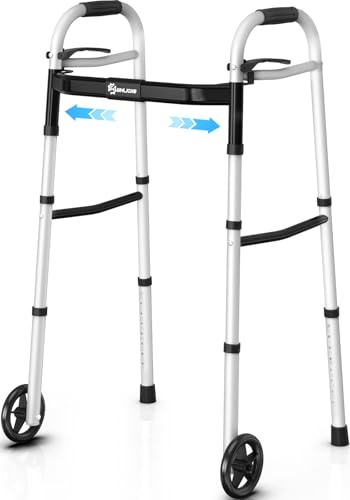
The Whlicks folding walker is crafted from robust aluminum alloy, delivering strong stability with a 350-pound weight capacity. Its lightweight design (about 6.6 pounds) supports easy handling and storage. The walker’s adjustable width (22.4–26.4 inches) and height (30.3–37.4 inches) ensure a comfortable fit through doorways, hallways, and bathrooms, enabling safer indoor mobility and smoother daily activities.
Delog Narrow Folding Walker With Trigger Release

Delog’s folding walker combines lightweight construction with practical features like a trigger release for easy folding in tight spaces. It offers width adjustability from 17 to 22 inches and can support up to 350 pounds. Independent side operation enhances stability when navigating narrow rooms, while its 4-wheel design provides reliable balance for indoor and outdoor use. The model is noted for compact storage and straightforward transition in/out of vehicles.
Vive Mobility Upright Walker With Seat

The Vive Upright Walker offers a distinct standing-support design with an integrated seat for resting. It features 8-inch flat-free wheels for stability across various surfaces and adjustable forearm pads to accommodate different arm lengths. Height is adjustable from 45 to 52 inches, making it suitable for a wide range of users. The rolling frame aims to reduce fatigue during longer outings and provides a comfortable resting option when needed.
Two-Button Folding Walker Without Wheels
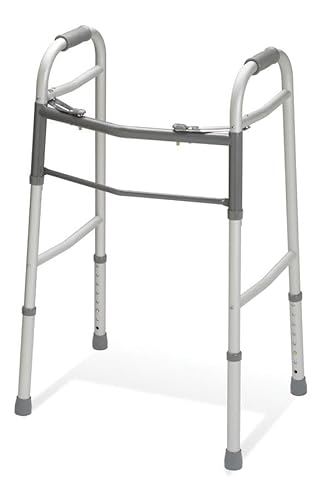
This no-wheel folding walker emphasizes stability and controlled pacing, with a simple two-button folding mechanism for quick storage. Without wheels, it offers deliberate balance and steady support, making it suitable for users who prioritize a more controlled, step-by-step gait. It remains compact and easy to transport in small living spaces or cars where wheeled options are unnecessary.
Buying Guide: Key Purchase Considerations
- Intended use and environment: Indoor-only walkers reward compact width and easy folding; outdoor models benefit from solid wheels and higher weight capacities for rougher surfaces.
- Weight capacity and build: Aluminum frames provide lightweight handling with sturdy support. Confirm the weight limit aligns with the user’s needs and consider future changes in mobility.
- Wheels vs. no wheels: Front and rear wheels enable smoother movement and reduced effort, while no-wheels designs offer more deliberate control and stability for cautious gait patterns.
- Adjustability: Height, width, and handle position influence posture, comfort, and usability. Look for models offering broad, simple adjustment ranges and secure locking mechanisms.
- Storage and portability: Folding capability and compact dimensions support travel, car storage, and room-to-room use in small living spaces.
- Safety features: Look for brakes or locking mechanisms, non-slip grips, and stable frames. Some models include seating for rest during activities or long walks.
- Maintenance and parts: Aluminum frames resist corrosion and are easier to maintain. Check for available replacement parts and warranties when evaluating long-term value.
- Accessibility and dexterity: For users with limited hand strength, consider easy-to-use folding buttons, grip-friendly handles, or trigger-release mechanisms that reduce the effort required to operate the walker.
- Versatility: A 2-in-1 or upright design can address multiple mobility needs—standing support, walking, and seating—providing a more flexible solution for varying daily routines.
- Budget and availability: Balance features against cost; many models offer similar functionality with different configurations. Assess local availability for timely support or repairs.
Choosing the right exercise walker involves balancing stability, ease of use, and space constraints. Review the product features, test the height and width adjustments, and consider how the walker will adapt to different rooms, doorways, and transport scenarios. A model that folds compactly, supports necessary weight, and offers reliable wheel performance is likely to support consistent activity and safer daily movements for the elderly.