Equipping a tennis court with a reliable ball machine can transform solo practice, improve consistency, and accelerate skill development. This guide highlights five top options across price points and features, helping players select a model that fits their pace, space, and goals. Each pick is evaluated on portability, control, ball capacity, and intelligent features to support focused drills and repeatable routines.
Chosen products at a glance
| Product | Brand | Key Features |
|---|---|---|
| Furlihong 3819BH Portable Tennis Ball Machine | Furlihong | 5 angle settings, 2 power levels, 4 serve intervals, up to 30 MPH |
| SCIFANTA Portable Tennis Ball Tosser | SCIFANTA | Automatic feed every 4 seconds, adjustable distance, suitable for all levels |
| PUSUN PT-Smart Tennis & Padel Ball Machine | PUSUN | App control, 12 presets, AI drill path, 100-ball capacity |
| PONGBOT Tennis Ball Machine | PONGBOT | App and remote control, 150-ball capacity, up to 80 mph, drills library |
| Lobster Sports Elite One | LOBSTER | Corner-to-corner oscillation, 4–8 hours runtime, lightweight |
The selections above emphasize a mix of portability, programmable drills, and varied ball delivery styles to suit beginners through advanced players. Each product section below provides specifics, including how its features translate into practice routines on the court.
Furlihong 3819BH Portable Tennis Ball Machine

The Furlihong 3819BH offers a lightweight, portable design ideal for practice on any court. It supports five adjustable angles to simulate forehand, backhand, flat shots, slices, and volleys, enabling well-rounded training. Two power levels and four serve interval settings let players tailor drills for speed, rhythm, and recovery between shots. This combination supports consistent practice sessions and progression across skill levels without heavy, stationary equipment.
SCIFANTA Portable Tennis Ball Tosser
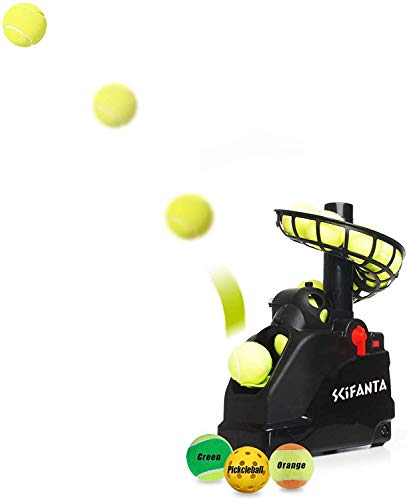
The SCIFANTA ball tosser focuses on consistent, repeatable feeds with a four-second interval. It’s designed for self-practice and is suitable for players across skill levels. The adjustable feed distance supports a range of drills—forehand, backhand, volleys, and baseline play—while encouraging independent practice. Its simple construction emphasizes dependable performance and predictable ball delivery for drill-focused sessions.
PUSUN PT-Smart Tennis & Padel Ball Machine

The PUSUN PT-Smart combines app-driven control with AI-assisted drills and a large ball capacity. Its 12 preset modes cover full-court coverage, including volleys, smashes, and backspin variations. The AI Drill feature personalizes practice paths by skill level and dominant hand, offering a scalable training plan from beginner to advanced. The inclusion of Padel drills expands its versatility for multi-sport practice sessions.
PONGBOT Tennis Ball Machine
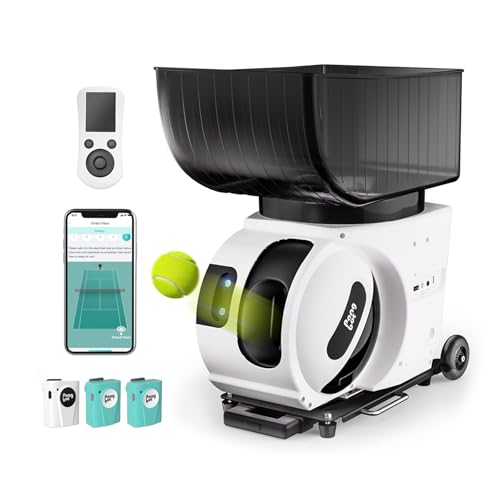
The PONGBOT model emphasizes breadth of drills with hundreds of pre-loaded scenarios and the ability to sync custom drills from an app to a remote. It supports long-term practice with recurring routines and a robust drill library. The dual-control setup (app and remote) enables on-court adjustments without returning to the machine, helping players maintain flow during practice sessions.
Lobster Sports Elite One

The Lobster Elite One balances advanced features with a competitive price point. Its corner-to-corner oscillation creates varied feeding patterns, simulating real-match movement. The machine offers a 4–8 hour runtime on a single battery charge, enabling longer practice sessions without frequent recharges. It provides a reliable option for players seeking broad shot randomization and extended court coverage.
Buying Guide
- Drill variety and programmability: Look for machines with presets, customizable drills, and AI or app-based programming to simulate match flow and ensure repeatable practice sessions.
- Portability and setup: If you travel to different courts, prioritize lightweight models with easy assembly and stable bases to minimize downtime between drills.
- Capacity and power: Battery life and ball capacity affect session length. More capacity and longer battery life reduce interruptions during solo practice.
- Control interfaces: Apps and remotes can save time and keep focus on technique. Consider whether you prefer smartphone integration or a dedicated controller on the unit.
- Delivery patterns: Oscillation, spin control, and adjustable launch angles influence how closely you can mimic real rallies. Multi-angle options help target specific strokes.
- Maintenance and warranty: Check for replacement parts, ease of cleaning, and warranty terms to ensure long-term reliability.
- Skill level alignment: Beginners benefit from simpler interfaces and guided drills, while advanced players may prioritize higher speeds, varied spins, and more complex patterns.
- Environment and space: Ensure the machine’s footprint and ball trajectory fit your practicing space. Consider models with compact storage if court space is limited.
When selecting a tennis ball machine, balance immediate practice needs with long-term training goals. The models highlighted here span basic portability, app-driven sophistication, and extended runtime, giving players options to evolve from introductory drills to comprehensive, drill-driven sessions.